
Small-Cap vs. Large-Cap Stocks: Why Interest Rates Can Affect Them Differently
When interest rates move, the effects can show up across the stock market, but not every company responds in the same way.
A change in rates can affect borrowing costs, business investment, consumer spending and how investors value future earnings. Those effects may look different for a smaller company than they do for a large, established business.
That is one reason small-cap and large-cap stocks can sometimes move differently even when they are reacting to the same economic news.
What Makes a Stock Small-Cap or Large-Cap?
The terms small-cap and large-cap refer to a company's market capitalization, or the total market value of its outstanding shares.
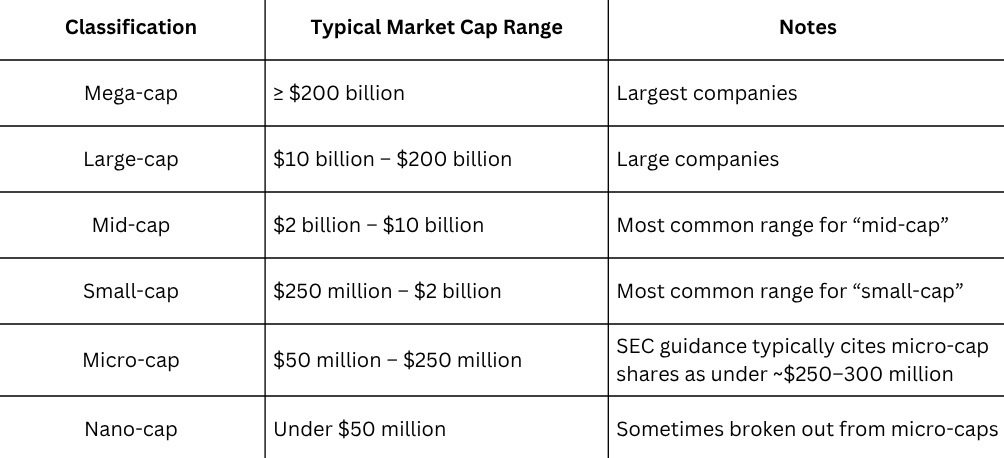
Large-cap and small-cap may, at times, be further divided into additional categories, but for the purposes of this article we will refer to the terms large-cap and small-cap. There is no single official or legally mandated definition used across the entire market, but widely-used industry conventions (e.g., from FINRA, SEC guidance, and common financial education sources) classify U.S. stocks by market capitalization generally as described in the table below.
Common Market Cap Tiers
The Russell 2000 is commonly used as a benchmark for smaller U.S. companies, while the S&P 500 is made up primarily of large U.S. companies.
Company size alone does not determine how a stock will perform, but it can influence how sensitive a business is to changes in interest rates and economic conditions.
Why Borrowing Costs Matter
One of the clearest ways interest rates affect companies is through the cost of borrowing money.
Businesses may borrow to fund expansion, purchase equipment or cover other operating needs. When rates rise, taking on new debt can become more expensive. Companies that need to refinance existing debt may also face higher costs.
Changes in interest rates may have a greater effect on smaller companies because they may have fewer ways to raise capital.
A large company may be able to issue bonds, use cash on hand or borrow at more favorable rates. A smaller company may depend more heavily on bank loans or other forms of financing.
That does not mean every small company carries more debt or every large company has easy access to capital. But when borrowing becomes more expensive, businesses with fewer financing options may feel the impact more quickly and to a greater extent.
The Economy Matters, Too
Interest rates can also affect consumer and business spending.
Higher rates can make mortgages, auto loans, credit cards and business loans more expensive. That can lead households and companies to becoming more selective about how they spend.
Many smaller U.S. companies generate a large portion of their revenue domestically, so their results may be closely tied to conditions in the U.S. economy.
Large multinational companies may generate revenue from several countries and markets, giving them a different mix of economic exposure.
This is another reason traders may see that small-cap and large-cap stocks respond differently when expectations for economic growth or interest rates change.
Lower Rates Do Not Automatically Mean Small Caps Will Rise
It can be tempting to reduce the relationship to a simple rule: higher rates are bad for small caps, while lower rates are good for them. Markets are more complicated than that.
The reason rates are moving matters.
For examples, rates may fall because inflation is easing while economic conditions remain stable. They could also fall because economic growth is weakening. These two scenarios can create very different conditions for businesses and investors.
The same is true when rates rise. An increase tied to stronger economic activity may have different implications than one caused by persistent inflation.
That is why the direction of interest rates alone does not determine how small-cap or large-cap stocks will perform.
What Traders Can Look At
Company size can provide context, but it is only part of the picture.
When considering how interest rates may affect a stock, traders can also look at how much debt the company carries, when that debt must be refinanced, how much cash the business generates, and how dependent the company is on additional financing.
It can also help to consider whether the company's customers are sensitive to borrowing costs and how much of its revenue comes from the U.S. versus other markets.
These factors can help explain why two companies of similar size may respond differently to the same change in rates.
The Bottom Line
Interest rates can affect stocks through borrowing costs, spending, business investment and broader economic expectations.
Small-cap companies may sometimes be more sensitive to those changes because they can have fewer financing options or greater exposure to the domestic economy. Large-cap companies may have broader access to capital, larger cash reserves or more diversified revenue sources.
But neither group moves according to a simple rule.
Understanding why rates are changing, and how an individual company's finances and business model may respond, can provide more useful context than looking at company size alone.
© 2026 Securities are offered by Lime Trading Corp., member FINRA, SIPC, NFA. Past performance is not necessarily indicative of future results. All investing incurs risk including, but not limited to, the loss of principal. Additional information may be found on our Disclosures Page. The material in this communication is not a solicitation to provide services to customers in any jurisdiction in which Lime Trading is not approved to conduct business. This communication has been prepared for informational purposes only and is based upon information obtained from sources believed to be reliable and accurate; however, Lime Trading Corp. does not warrant its accuracy and assumes no responsibility for any errors or omissions. The information provided is not an offer to sell or a solicitation of an offer to buy any security or a recommendation to follow a specific trading strategy. Lime Trading Corp. does not provide investment advice. This material does not and is not intended to consider the particular financial conditions, investment objectives, or requirements of individual customers. Before acting on this material, you should consider whether it is suitable for your particular circumstances and, as necessary, seek professional advice.