
Are Equities Whistling Past the Graveyard?

The Treasury market is repricing the cost of capital aggressively, while equities remain remarkably unperturbed. We look at three places where investors should pay attention: leverage, free cash flow, and valuation.
The bond market is sending an increasingly difficult signal for equity investors to ignore.
The 2-year Treasury yield is approaching 5%. Everything from three years onwards is already trading with a 5-handle. The 10-year crossed 5% and seemingly continues north while the 30-year is pushing into the high-5s.
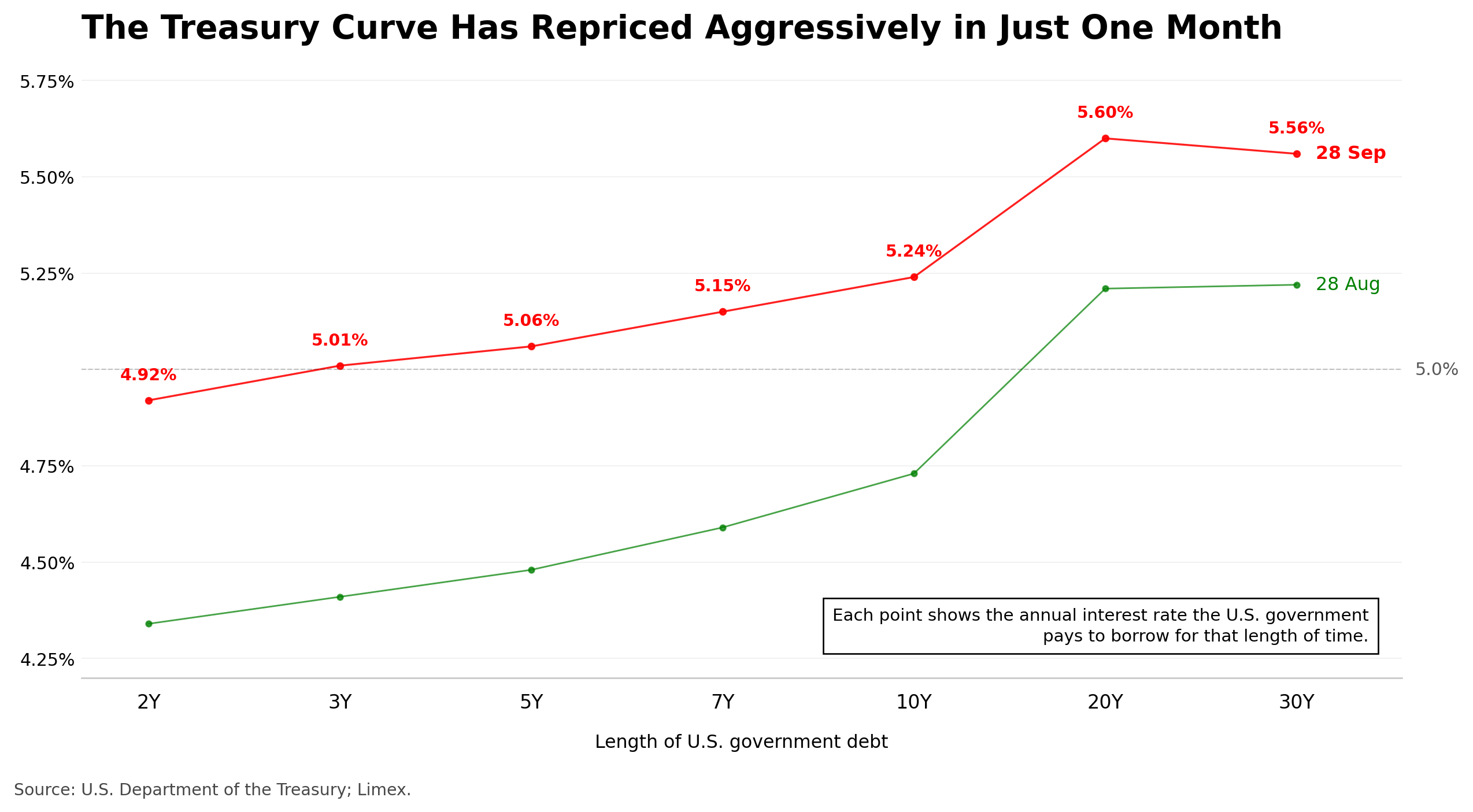
This repricing has happened remarkably quickly: in just one month, yields have risen by roughly 35–60 basis points across the curve. Moves of this magnitude are rare. The closest recent analogue is the 2022 inflation shock, when the Federal Reserve was raising rates at 75 basis points per meeting. This is not an isolated sell-off at one end of the yield curve, but a rapid, broad repricing of the cost of capital across maturities.
Equities, meanwhile, appear remarkably blasé.
Perhaps they are right. Earnings remain strong, nominal growth is supportive, and some companies can comfortably generate returns well above today's higher cost of capital. This is not a prediction of an imminent equity-market crash, but the divergence likely deserves attention.
There is an old market lesson: You can fool the equity market for a while. You can bully commodity traders. But you cannot force the bond market.
That distinction seems particularly appropriate today. Oil futures are trading every geopolitical headline. Equities continue to trade earnings, growth, and enthusiasm around AI. But the Treasury market ultimately must answer a more prosaic question: What return does an investor require to provide capital for two, ten, or thirty years?
Increasingly, the answer is around 5% or more, depending on maturity.
And that changes the math underneath both corporate financing and equity valuation, whether the equity market acknowledges it immediately or not.
Three Numbers To Watch
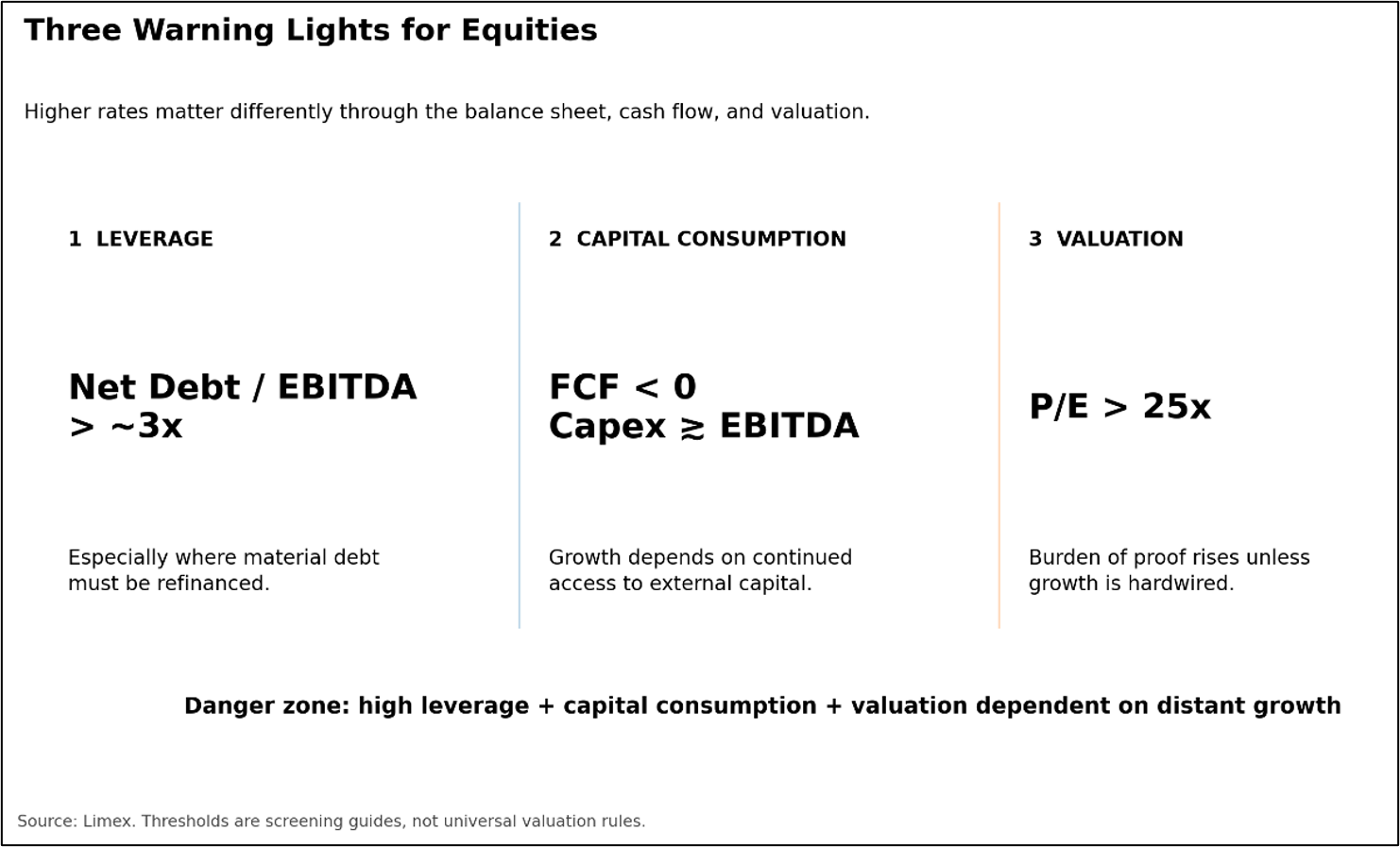
There are three fairly simple measures worth putting through an equity screener.
1. Net Debt / EBITDA
The first warning light is leverage values above roughly 3x Net Debt / EBITDA, particularly where substantial maturities require refinancing over the next several years.
There is nothing magical about 3x, and leverage is not inherently problematic. A stable company producing substantial cash can comfortably support debt. The problem is the interaction between leverage and the changing price of money. Debt raised when risk-free rates were 1–2% does not remain cheap forever. As maturities roll over, today's Treasury curve progressively works its way into corporate interest expense.
A balance sheet built for cheap money eventually has to refinance in the world that actually exists.
2. Free Cash Flow
Leverage becomes considerably more concerning when the company is also a net consumer of capital.
A leveraged company producing substantial free cash flow has choices. It can reduce investment, repay debt, accumulate cash, or allow leverage to decline as earnings grow.
A company consuming cash may have fewer of those choices, depending on its cash reserves and funding access.
Pay particular attention to businesses in which capital expenditure approaches or exceeds EBITDA, free cash flow is negative, and the balance sheet is already meaningfully leveraged.
These may be great businesses over the long run. Rapid growth may be precisely why they consume so much capital. But delivering that growth requires somebody to keep supplying the money.
At very low interest rates, that requirement could almost become an afterthought. At 5%+, the financing architecture becomes part of the investment thesis.
Growth must produce sufficient returns not merely to justify the investment, but also to compensate for an increasingly expensive capital structure and the time between spending the money and receiving the resulting cash flow.
Cash flow pays the bills. Balance sheets buy time.
3. Valuation
The third filter catches a different form of interest-rate exposure.
A company can have no debt, enormous cash balances, and fantastic operating economics, yet its stock price may still be vulnerable to higher long-term rates if investors are paying today for cash flows expected far into the future.
That is simply duration.
PEG below 1x remains an attractive first-pass indication that investors are not paying an excessive multiple for growth. But with risk-free rates around 5%, some traders treat 25x+ P/E equities as “guilty until proven innocent.”
That does not mean 25x is necessarily expensive. It means the burden of proof has changed.
At those valuations, traders may want growth that is hardwired rather than simply forecast: contracted revenues, committed customers, recurring revenues with demonstrably high retention, durable pricing power, visible capacity against existing demand, structural market-share gains, or another unusually high-confidence path from today's earnings to tomorrow's cash flows.
A hockey-stick consensus spreadsheet consisting of a long, flat period of slow or minimal growth (the shaft/blade) followed by a sudden, dramatic and steep upward explosion in revenue or profits (the blade/curve), built using aggregated market or team expectations does not qualify.
At 25x earnings with a 5%+ risk-free alternative, strong growth may no longer be sufficient. Investors should be able to explain where the growth will come from, who will pay for it, how it will be financed, and why the returns on the capital required to produce it exceed the increasingly expensive cost of that capital.
Follow the Cash
None of these measures works particularly well in isolation.
A highly valued company with net cash, enormous free cash flow, and unusually visible growth may comfortably justify its multiple. A leveraged company producing enough cash to rapidly repair its balance sheet may be equally attractive.
The combination that may be perturbing to investors is: High leverage + capital consumption + a valuation dependent upon distant growth.
Such companies may have extraordinary assets and tremendous growth opportunities. They may ultimately deliver everything investors expect of them.
But their margin for error is likely getting smaller.
Debt / EBITDA tells how constrained the balance sheet is. Free cash flow tells whether the company needs somebody else's money. Valuation tells how much of today's share price depends upon tomorrow going according to plan.
The Treasury market does not know where equities are going tomorrow. But it is setting the price against which corporate financing, investment projects, acquisitions, buybacks, and ultimately equity cash flows must compete.
Equities can ignore that price for a while. They most likely cannot avoid it indefinitely.
You can fool the equity market for a while. You can bully commodity traders. But you cannot force the bond market.
Perhaps equities have not yet gotten the memo.
© 2026 Securities are offered by Lime Trading Corp., member FINRA, SIPC, & NFA. Past performance is not indicative of future results. All investing incurs risk including, but not limited to, the loss of principal. Additional information may be found on our Disclosures Page. The material in this communication is not a solicitation to provide services to customers in any jurisdiction in which Lime Trading is not approved to conduct business. The material in this communication has been prepared for informational purposes only and is based upon information obtained from sources believed to be reliable and accurate; however, Lime Trading Corp. does not warrant its accuracy and assumes no responsibility for any errors or omissions. The information provided is not an offer to sell or a solicitation of an offer to buy any security or commodity or other financial product and is not a recommendation to follow a specific trading strategy. Lime Trading Corp. does not provide investment advice. This material does not and is not intended to consider the particular financial conditions, investment objectives, or requirements of individual customers. Before acting on this material, you should consider whether it is suitable for your particular circumstances and, as necessary, seek professional advice.