
Bessent v. the Bond Market: Who Prices Risk?

Bessent Takes On the Bond Market
Treasury Secretary Scott Bessent's decision to expand planned buybacks in the long end of the U.S. Treasury market has become one of the more consequential market stories of the past few days.
The development may also have implications for equity investors.
The Treasury curve is the foundation on which much of the rest of the financial system is priced. Higher long-term yields can feed into corporate borrowing costs and, over time, influence mortgages, housing activity, auto financing, and the cost of fixed-asset investment.
For equities, the effect can arrive from both directions: higher discount rates can reduce what investors are willing to pay for future earnings, while higher financing costs and weaker economic activity can begin to reduce the earnings themselves. The pressure can be more pronounced in leveraged and richly valued parts of the equity market.
For now, plentiful liquidity can provide an important buffer for stock market valuations. Cash remains abundant across the financial system, which can allow investors, companies, and consumers to absorb higher financing costs without immediately changing behavior. That can keep equity valuations and risk appetite elevated even while the underlying cost of capital is moving against them. But liquidity can delay the adjustment; it does not eliminate the higher cost of capital. The longer that rates remain elevated, the more that buffer is gradually consumed.
Bessent Arm-Wrestles the Bond Market
After the 30-year Treasury yield touched 5.34% on August 18, its highest level since 2007, Treasury announced that it would at least double the size of its buybacks in the 10- to 30-year sectors, from $2 billion to $4 billion per operation.
The announcement was followed by the 30-year yield falling as low as 5.19%, although much of the move was subsequently reversed. Bessent has since suggested Treasury could go further: “We have a big toolkit so we'll see,” he said, while arguing that current yields “don't reflect the underlying fundamentals.”
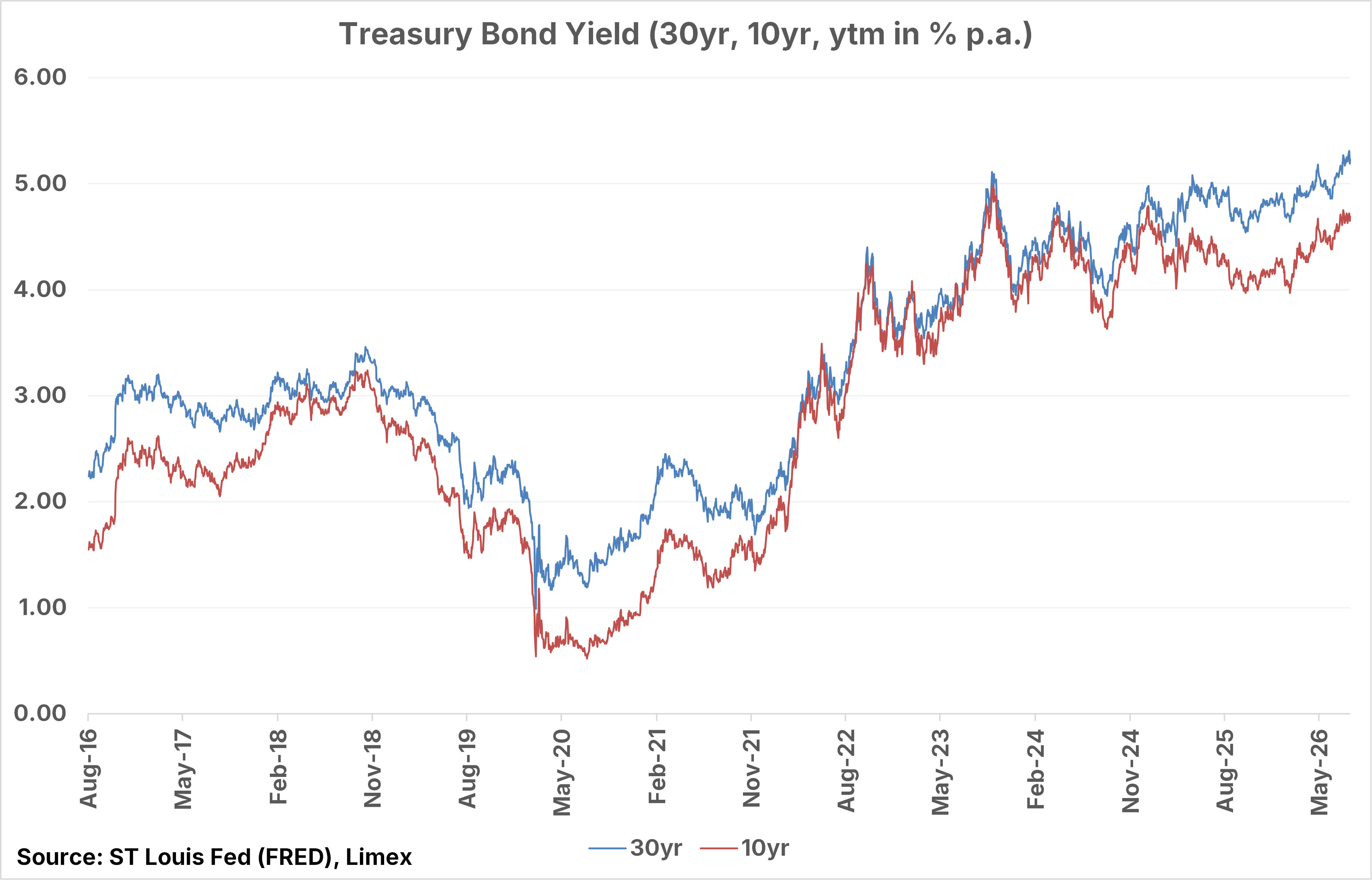
Long-term Treasury yields have continued to rise despite lower policy rates, with the 30-year yield now above 5%. The widening gap between 10- and 30-year yields may reflect an increasing price being demanded for duration risk.
Treasury has characterized the expanded buybacks as providing greater liquidity support to longer-dated securities. We find that explanation incomplete. The 10- and 30-year yields attracting attention are benchmark yields established in the most liquid, on-the-run part of an already extraordinarily liquid Treasury market (10-year and longer Treasury securities trade well in excess of $200 billion on an average day, making Treasury's purchasing power marginal relative to even a single day's turnover). Off-the-run (i.e., not the most recently issued) securities can certainly suffer liquidity discounts, and buybacks can improve their marketability. But that is a different problem from investors demanding a higher yield to hold long-term U.S. government debt.
Liquidity can explain why one Treasury trades cheaper than another. It is much harder to use it to explain why the entire long end reprices.
Bessent's own language makes the distinction important. If long-term yields “don't reflect the underlying fundamentals,” then the objection appears to extend beyond market plumbing. It is also about price. Treasury may call the program liquidity support, but the combination of larger planned purchases, rising benchmark yields, and the Secretary explicitly questioning those yields makes it reasonable to ask whether Treasury is beginning to resist the market's clearing price for duration.
The timing matters.
The announcement comes just as Federal Reserve Chairman Kevin Warsh is attempting to redefine the boundary between monetary policy and financial markets. Warsh's emerging framework appears to envisage a Fed that remains responsible for the price and availability of liquidity capital, while placing greater weight on the market’s role in pricing risk capital — particularly duration risk.
That makes Bessent's actions considerably more interesting.
Just as Warsh appears to favor a more limited Fed role in guiding the price of long-term risk, Treasury appears increasingly willing to intervene when officials question the prices markets produce.
This is not necessarily a contradiction. Treasury and the Fed have different mandates, and Treasury buybacks have legitimate market-functioning purposes. But it creates an increasingly important divide over who ultimately determines the cost of long-term capital in the United States.
In simplified terms, the Fed prices liquidity. The market prices risk.
The question raised by Bessent's intervention is what happens when Treasury does not like the market's answer.
Treasury Finds $1 Trillion — Sort Of
Treasury officials suggested that Bessent could potentially draw on the nearly $1 trillion held in the Treasury General Account (TGA) to expand purchases of longer-dated Treasuries. On the surface, that could transform a program measured in billions of dollars per operation into one potentially backed by hundreds of billions of dollars of additional purchasing power.
But it is not as though Treasury found $1 trillion rummaging through the couch pillows. The Treasury General Account (TGA) is the government's operating cash account. That money is already there to fund government expenditures and manage Treasury's enormous day-to-day financing requirements.
And money is fungible.
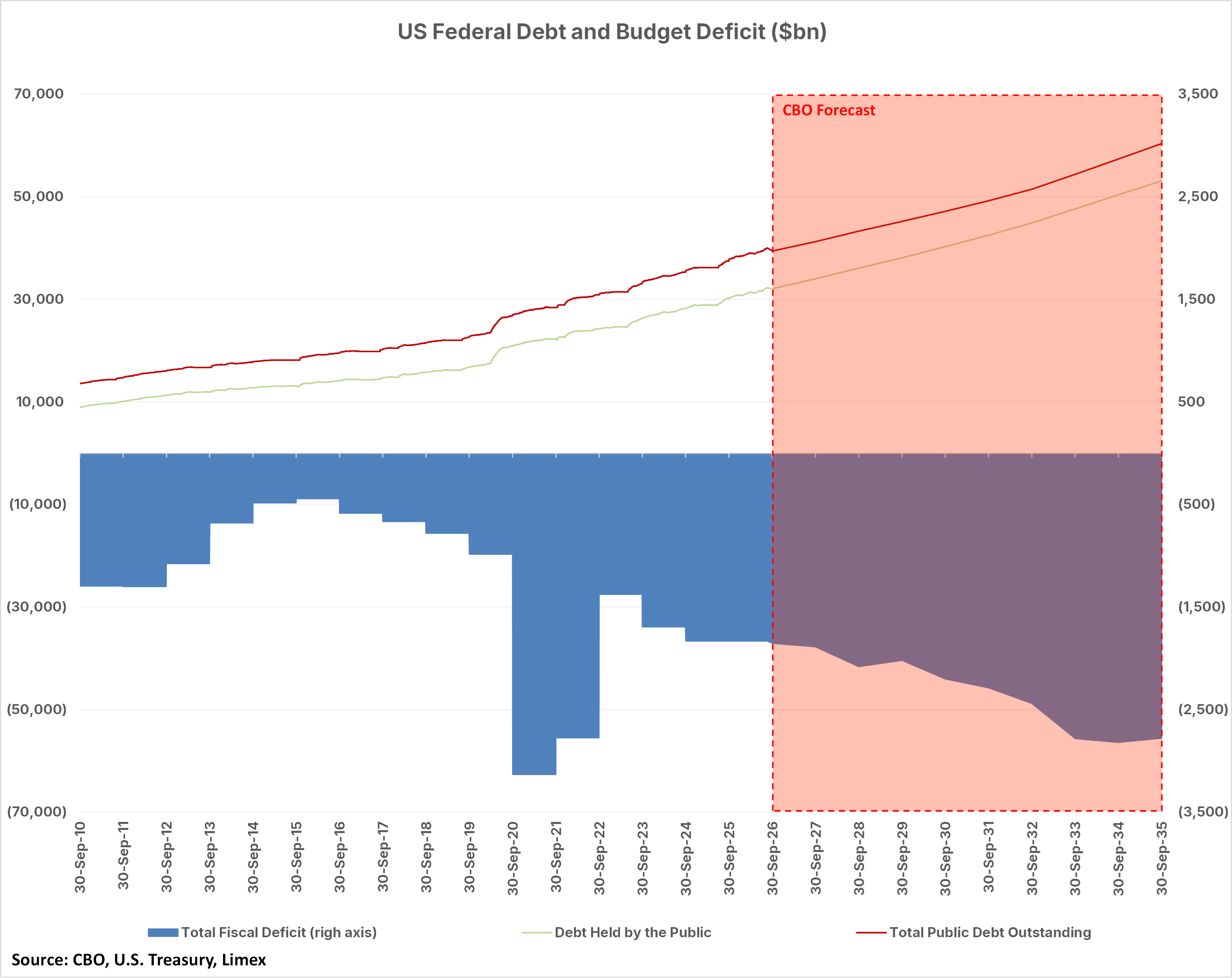
The nearly $1 trillion held in the TGA sits against a much larger structural financing requirement. Federal debt is approaching $40 trillion, while CBO expects annual deficits to remain around $2 trillion or more throughout the forecast period.
The chart puts that $1 trillion in perspective. The United States is already running a fiscal deficit approaching $2 trillion a year, and CBO expects deficits to remain extraordinarily large throughout its forecast period. If Treasury takes $100 billion from the TGA and spends it buying long-term bonds, that is $100 billion no longer available to fund government operations. Unless spending falls or revenues rise by the same amount, Treasury must ultimately raise an additional $100 billion in the market to finance those operations.
In practice, that means the transaction can become a maturity swap: Treasury uses its cash to retire long-term debt and replaces the cash through new borrowing, likely concentrated toward the shorter end of the curve. The TGA allows Treasury to separate the two transactions in time. Money being fungible, it cannot separate them economically.
A $1 trillion cash balance gives Treasury considerable ammunition. It does not give Treasury a printing press.
The mechanics are worth considering. Imagine Treasury buys $1 of face-value long-term debt trading at 80 cents on the dollar and finances the purchase, directly or ultimately through its broader borrowing program, by issuing 80 cents of shorter-term debt at par. Treasury has retired $1 of debt while issuing only 80 cents to replace it. The transaction therefore reduces the face value of debt outstanding by 20 cents and, depending on its accounting treatment, may also recognize some benefit from retiring the liability below par.
But the cash flows tell a different story.
If the retired bond carries a 2% coupon, Treasury eliminates two cents of annual interest. If the 80 cents of replacement borrowing costs 4%, however, the replacement debt carries 3.2 cents of annual interest. Annual interest expense has therefore increased by a net 1.2 cents. Debt outstanding has fallen, while annual cash interest expense has increased. Treasury has also exchanged long-term fixed-rate funding for a liability that must be refinanced considerably sooner.
In other words, Treasury can reduce the face value of debt outstanding by buying back debt below face value, but may do so by giving up the cheap financing embedded in that debt. Buying a dollar of 2% debt for 80 cents looks attractive until one asks where the 80 cents came from.
If it came from issuing new debt at 4%, Treasury has improved the face-value arithmetic while worsening the cash-flow arithmetic.
At sufficient scale, the trade becomes more problematic still. Funding long-duration purchases with shorter-term issuance increases supply at the front of the curve, potentially putting upward pressure on short-term rates. Meanwhile, if private investors continue to demand a higher term premium, Treasury's purchases may prove insufficient to prevent long-term yields from rising anyway.
Treasury could therefore face higher short-term funding costs without sustainably lower long-term yields.
The Balance-of-Payments Problem
The international balance of payments makes the constraint tighter still. When the United States runs a trade deficit, the dollars it sends abroad to pay for imports do not simply disappear from the global financial system. U.S. current-account deficits are generally accompanied by net financial inflows, and a significant share of foreign capital has historically found its way into Treasuries. In that sense, trade deficits can be associated with capital inflows that help finance U.S. borrowing.
Policies intended to reduce the trade deficit can push in the opposite direction. To the extent tariffs and industrial policy reduce the trade deficit, they may also alter the flow of dollars accumulating abroad that can subsequently be recycled into U.S. financial assets. That does not mean foreign investors stop buying Treasuries — capital will move in response to relative returns, currency expectations, reserve requirements, and risk — but it does make the price required to attract the marginal foreign dollar increasingly important.
One important part of that price is the yield.
Washington's policy objectives are therefore becoming increasingly difficult to reconcile: reduce the trade deficit, maintain low taxes, leave politically difficult Social Security and healthcare reforms largely untouched, finance a roughly $2 trillion fiscal deficit, and simultaneously seek to limit increases in the market price of long-term capital.
Some adjustment eventually has to occur. Either the fiscal deficit falls, domestic savings rise, foreign capital continues to arrive for reasons other than the recycling of trade dollars, or the price offered to investors rises. In the absence of substantial fiscal reform, that adjustment may increasingly fall on interest rates.
Against that backdrop, even the headline $1 trillion of potential Treasury firepower looks less imposing. It represents only a few percent of the outstanding Treasury market. If that cash is ultimately replaced with shorter-term borrowing, Treasury may also pull a substantial amount of refinancing requirements forward — spending today's cash buffer and creating tomorrow's refinancing needs without any assurance that long-term yields remain lower.
There is another problem: everyone knows the $1 trillion is finite. Even treating the entire TGA as genuinely additional firepower, it is effectively Treasury's last bullet in the holster. Markets do not necessarily have to wait for the account to run dry before reacting. As the intervention progresses, investors are likely to begin pricing the limits of Treasury's buying capacity before the final dollar is spent.
That makes the exercise inherently vulnerable to anticipation. Treasury is attempting to influence a continuing flow of market prices with a finite stock of cash. The market, meanwhile, knows approximately how large that cash stockpile is, can observe it declining, and knows that the government's underlying borrowing requirement continues after it is gone. The closer Treasury gets to exhausting its firepower, the less credible each remaining dollar of intervention may become.
Treasury eventually has to return to the same market for financing. The larger the intervention, the more cash it consumes, the more refinancing risk it pulls forward, and the more visible the eventual funding requirement may become.
There is an interesting fiscal wrinkle. Buying discounted long-term debt can produce a marginal reduction in reported debt outstanding, while the immediate budgetary consequences may look considerably better than the longer-term cash-flow economics. If the purchases are ultimately financed with shorter term debt at higher rates, the liability has not disappeared; it has largely been transformed — from cheaper, long-term financing into more expensive debt that comes due sooner.
That is the fundamental limitation of Treasury intervention. It can anticipate the limits of its buying capacity. And Treasury still has to finance its broader obligations.
The numbers can look better before the economics do.
In simplified terms, the Fed prices liquidity. The market prices risk. Treasury ultimately still finances itself within that market.
And history offers a useful warning about trying to prove otherwise: you can fool the equity market, and you can bully commodity traders. But you cannot force the bond market.
© 2026 Securities are offered by Lime Trading Corp., member FINRA, SIPC, & NFA. Past performance is not indicative of future results. All investing incurs risk including, but not limited to, the loss of principal. Additional information may be found on our Disclosures Page. The material in this communication is not a solicitation to provide services to customers in any jurisdiction in which Lime Trading is not approved to conduct business. The material in this communication has been prepared for informational purposes only and is based upon information obtained from sources believed to be reliable and accurate; however, Lime Trading Corp. does not warrant its accuracy and assumes no responsibility for any errors or omissions. The information provided is not an offer to sell or a solicitation of an offer to buy any security or commodity or other financial product and is not a recommendation to follow a specific trading strategy. Lime Trading Corp. does not provide investment advice. This material does not and is not intended to consider the particular financial conditions, investment objectives, or requirements of individual customers. Before acting on this material, you should consider whether it is suitable for your particular circumstances and, as necessary, seek professional advice.