
Bessent Can Trade the Treasury Market, But He Can’t Price It

Highlights
- Rising Treasury yields can create an increasingly challenging backdrop for aggressive growth stocks. The 10-year yield is approaching 5%, while long-term inflation expectations remain relatively anchored, pushing real risk-free rates sharply higher and increasing the valuation sensitivity of growth equities.
- Higher real rates do not necessarily imply an imminent market correction. Liquidity remains abundant enough that higher real rates may not force immediate repricing, but the valuation cushion is narrowing, and the risk/reward is becoming progressively less attractive.
- This is increasingly a real-rate story, not an inflation story. Long-term inflation breakevens have remained relatively anchored while nominal Treasury yields have climbed, implying that investors are demanding much higher real returns for supplying long-term capital. Inflationary pressures tend to be cyclical; the forces pushing real rates higher are more secular and therefore risk becoming a persistent feature of the cost of capital.
- Bessent’s rhetoric has been considerably tougher than his actions. He talks like a policymaker prepared to manage markets, but acts like one managing liquidity. Treasury buybacks remain small relative to the market, targeted at less-liquid securities, and financed elsewhere on the government’s balance sheet. There is little evidence of anything resembling quantitative-easing (QE) or yield-curve control (YCC).
- More importantly, the market may be overlooking the link between trade and interest rates. Trading partners running surpluses with the U.S. accumulate dollars, which may be recycled back into U.S. assets including Treasuries. Those purchases can help finance American deficits, contribute to lower domestic interest rates, and support economic activity—which, in turn, supports U.S. consumers buying more imported products.
- Smaller trade deficits may interrupt that recycling loop, potentially putting upward pressure on American rates and weighing on the economy. Less trade-related dollar accumulation abroad may reduce one source of demand for U.S. assets, and Treasury may become increasingly reliant on price-sensitive investors who may demand higher real yields to absorb the debt. Reducing American trade deficits may therefore put upward pressure on U.S. real interest rates.
- Bessent can manage the journey, but the market still determines the destination. Treasury can provide liquidity, influence positioning, and dampen disorderly moves. It cannot determine the equilibrium price at which investors are willing to supply long-term capital.
The Real Price of Long-Term Capital is Rising
The 10-year Treasury yield is once again approaching 5%, for only the second time in nearly two decades. The previous episode came during the post-COVID economic reactivation and inflation shock of 2023; before that, 5% yields had not been seen since 2007.
This time, however, it is not primarily an inflation story.
Despite elevated oil prices, geopolitical uncertainty, and persistent inflation, long-term inflation expectations have remained relatively stable. The 10-year inflation breakeven—the difference between nominal Treasury and TIPS yields—remains broadly anchored in the low-to-mid 2% range. Most of the increase in nominal yields has instead come through increasing real rates.
10yr Treasury Yields Rising Without Expectations for Higher Inflation
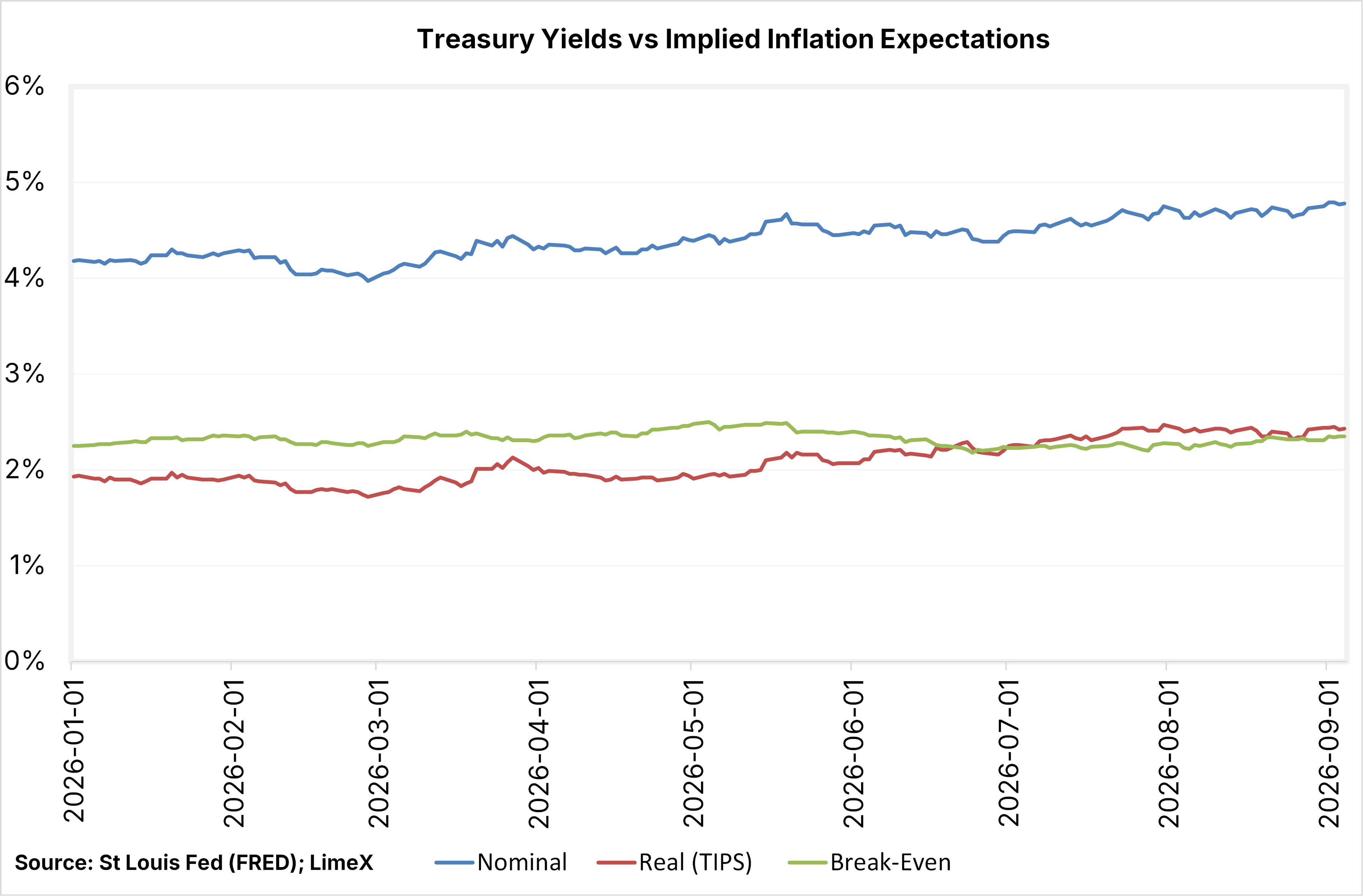
The rise in long-term Treasury yields has been driven predominantly by higher real rates rather than a material increase in long-term inflation expectations.
That distinction matters. Investors are not principally demanding compensation for higher expected inflation. They are likely demanding a higher real return to commit capital for a decade.
A Different Kind of Bond Sell-Off
There is no single explanation for rising real yields. Stronger expected economic growth can raise equilibrium real rates. Expectations for future Federal Reserve policy matter. So do fiscal deficits, Treasury issuance, global sovereign-bond supply, and term premia.
But the distinction between inflation and real rates is important for another reason. Inflationary pressures are generally cyclical: they rise and fall with commodity prices, supply constraints, demand, and monetary policy. The forces now pushing up the real cost of long-term capital appear to be more structural. Persistent fiscal deficits, large financing requirements, changing foreign demand, and a less accommodating international capital-flow environment together risk keeping real rates higher even after the current inflation cycle has passed.
One of those structural changes seems particularly underappreciated. The market may be underestimating the relationship between trade and Treasury yields. They are inherently joined through the balance of payments.
Trading partners running surpluses with the United States accumulate dollars. Those dollars do not simply disappear: they usually end up building dollar-denominated reserves, historically including substantial holdings of Treasury securities and Agency mortgage-backed securities issued or guaranteed by Fannie Mae and Freddie Mac. Those purchases can help finance American fiscal deficits and mortgages, contribute to lower domestic interest rates and support stimulating the economy—which, in turn, support U.S. demand for imported products.
It is a recycling loop.
U.S. Main Trade Deficit Countries & Main Foreign Treasury Holders
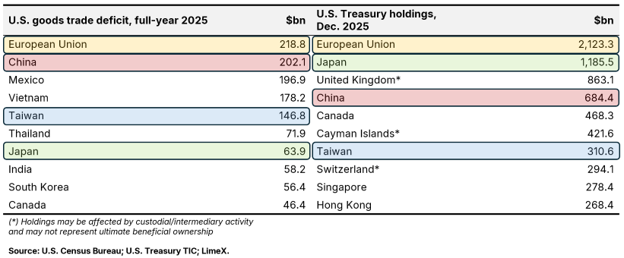
Countries running persistent trade surpluses with the United States accumulate dollars that may be recycled into U.S. assets. Treasuries have historically been an important destination for those flows.
There are important exceptions to the bilateral pattern. Canada and Mexico in North America, and Vietnam in Asia-Pacific, are deeply integrated into multinational supply chains. A greater share of their trade-related dollar flows can therefore recycle through intra-company payments, imported inputs, profit remittances, and other private capital flows rather than accumulating as central-bank reserves. The balance-of-payments recycling mechanism remains, but is less visible in official Treasury holdings.
This does not mean every dollar of trade surplus becomes a Treasury purchase. Foreign investors can buy equities, corporate securities, property, direct investments, deposits, and many other assets. Nor should today's bilateral trade balance map directly onto today's stock of Treasury ownership, which reflects decades of accumulated flows.
But the underlying balance-of-payments relationship remains. Smaller trade deficits may interrupt the recycling loop: fewer dollars accumulate abroad, fewer need to return to U.S. assets, and a greater share of Treasury's financing requirement must be absorbed by price-sensitive investors. Reducing American trade deficits could therefore put upward pressure on U.S. real interest rates and, eventually, weigh on economic activity.
That shift is occurring as other sources of relatively price-insensitive Treasury demand are also weakening. Japan's higher domestic yields and monetary normalization may reduce the relative appeal of Treasuries to Japanese investors, while China has substantially reduced its official Treasury holdings over time. Neither suggests a buyers' strike, but both are consistent with a shift toward more price-sensitive demand.
As passive and relatively price-insensitive demand recedes, more U.S. debt competes for price-sensitive capital. That shift could require higher real yields to attract investor demand.
Bessent Is Working the Plumbing
Treasury Secretary Scott Bessent has attracted considerable attention for his willingness to intervene around both the Treasury market and the Japanese yen. His rhetoric has often suggested a policymaker willing to confront markets directly.
His actions tell a rather different story.
Treasury's liquidity-support program purchases off-the-run securities across different maturity buckets. Recent long-end operations have been tiny relative to the Treasury market and the government's overall financing requirement.
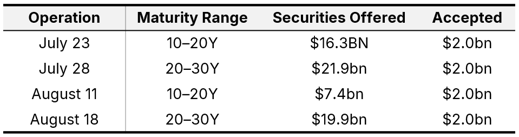
Source: U.S. Treasury debt buyback operation results.
Treasury has since increased the scale of its long-end liquidity support, including an operation to purchase up to $6 billion of 10–20 year securities. Yet long-term yields have continued to climb. The 10-year has moved further towards 5%, while the 30-year has moved above 5%.
That does not prove the operations have no effect. The counterfactual cannot be observed: yields might have risen further without them.
But it does illustrate an important distinction.
Treasury is not the Federal Reserve.
The Fed can create reserves and purchase securities, removing duration from private balance sheets. Treasury cannot. Treasury buybacks of securities ultimately have to be financed elsewhere within its liability structure.
Treasury's ammunition is therefore finite and transparent. Investors can observe its cash position, issuance program, buyback schedules and limits, and, afterwards, exactly how much was purchased.
Trying to defend an inconsistent yield with that balance sheet would invite investors to test a finite pool of resources. A veteran bond and currency trader such as Bessent is likely familiar with that asymmetry.
That does not make the buybacks pointless.
Different parts of the Treasury market have very different pools of liquidity. Treasury can purchase relatively illiquid, off-the-run long-term securities while financing itself in deeper, more liquid markets. The debt does not disappear, but Treasury can alter where it sits.
That is better understood as liquidity transformation than quantitative easing.
The distinction also provides a different interpretation of Bessent's trading instincts.
His rhetoric is considerably tougher than his actions. Bessent talks like he wants to manage the market, but acts like he wants to manage its liquidity.
That makes sense. As an experienced bond trader, Bessent is familiar with the risks of locking horns with markets this large using a finite balance sheet. His interventions increasingly appear designed not to determine the direction of interest rates, but to manage the volatility of the journey.
Treasury may not be able to prevent real yields from moving from 1.8% to 2.4% if that is where supply and demand ultimately clear. It can try to prevent that adjustment from becoming a disorderly sequence of price gaps, forced deleveraging, disappearing liquidity, and self-reinforcing selling.
Bessent can try to talk volatility away without pretending he can talk the market price away. So far, yields have continued to rise, but to some, the move seems more orderly.
The Yen Is Part of the Treasury Story
Bessent's intervention around the yen may fit the same framework.
His principal concern may not be the level of the yen itself. A related risk is the transmission of disorderly currency markets into the Treasury market.
The yen has long been an important funding currency for leveraged carry trades. Yen depreciation by itself does not necessarily force those positions to unwind; indeed, it can improve the economics of a short-yen carry trade.
The danger comes when disorderly depreciation raises the probability of intervention, monetary tightening, or a violent reversal in the currency. A jump in volatility can force leveraged investors to reduce positions, repay yen funding, and sell foreign assets. Treasuries can be caught in that deleveraging.
Seen this way, Bessent's warning to currency traders that “I am the house now” is more interesting than simply an attempt to talk up the yen. Bessent framed his advantage in event-driven FX trading as informational, pointing to his insight into potential actions by Japanese policymakers and the Bank of Japan.
That information itself has value.
If leveraged traders believe Treasury and Japanese authorities can intervene unexpectedly, the attractiveness of a large one-way position may deteriorate. Bessent does not necessarily need to determine the yen's fundamental value. In this framework, the objective is for traders to recognize that the distribution of potential outcomes has changed.
“I am the house now.” — Scott Bessent
The threat matters less because Treasury has unlimited financial resources—it does not—than because policymakers may possess an informational advantage over event-driven traders.
In this interpretation, the Treasury and FX actions share a common objective: prevent directional moves from becoming volatility events capable of feeding back into the Treasury market.
The Market Still Prices Money
This interpretation gives Bessent considerably more credit than viewing the buyback program as an unsuccessful attempt at yield-curve control.
He can influence the plumbing. He can shift issuance towards deeper pools of capital. He can support liquidity in less liquid portions of the curve. In currency markets, Bessent can use Treasury's informational advantage to discourage one-way speculative positioning. And through communication, he has the ability to alter the perceived distribution of outcomes confronting leveraged investors.
What he cannot do is determine the equilibrium price of long-term capital.
There has been no QE-style removal of Treasury duration from private balance sheets and no yield-curve-control commitment to defend a particular interest rate. Treasury is rearranging liabilities inside a market whose ultimate clearing price remains determined by investors.
That reiterates the following:
Inflation breakevens remain comparatively anchored while real yields have risen sharply. Whatever combination of stronger growth, fiscal supply, changing foreign demand, term premium, or other factors ultimately explain the move, the observable result is a substantially higher real risk-free rate.
And unlike a cyclical inflation shock, some of the forces behind that increased risk are becoming persistent. A structurally larger fiscal financing requirement confronting a more price-sensitive pool of capital may represent a durable increase in the real cost of money rather than another phase of the inflation cycle.
That matters well beyond Washington.
A higher real risk-free rate raises the hurdle rate throughout a leveraged economy. Some borrowers may eventually refinance at higher rates. Long-term investments may become less attractive. And equities compete against government securities offering increasingly substantial real returns without the same equity-market risk.
Aggressive growth stocks are specifically exposed because a disproportionate share of their valuation depends on earnings far into the future. Higher real rates reduce the present value of those earnings while relatively increasing the potential return available elsewhere.
That dynamic does not necessarily point to an imminent equity-market correction. Liquidity conditions remain abundant, and abundant liquidity can sustain expensive valuations considerably longer than valuation models alone would suggest.
But the direction of travel matters.
As the real risk-free rate rises, the prospective upside available from already expensive equities may compress while the downside associated with disappointment may grow.
Bessent can manage how markets get from one price to another. His experience may influence how he approaches this process.
But he does not have the balance sheet to determine what that price ultimately is.
Bessent can trade the Treasury market. He can't price it.
© 2026 Securities are offered by Lime Trading Corp., member FINRA, SIPC, & NFA. Past performance is not indicative of future results. All investing incurs risk including, but not limited to, the loss of principal. Additional information may be found on our Disclosures Page. The material in this communication is not a solicitation to provide services to customers in any jurisdiction in which Lime Trading is not approved to conduct business. The material in this communication has been prepared for informational purposes only and is based upon information obtained from sources believed to be reliable and accurate; however, Lime Trading Corp. does not warrant its accuracy and assumes no responsibility for any errors or omissions. The information provided is not an offer to sell or a solicitation of an offer to buy any security or commodity or other financial product and is not a recommendation to follow a specific trading strategy. Lime Trading Corp. does not provide investment advice. This material does not and is not intended to consider the particular financial conditions, investment objectives, or requirements of individual customers. Before acting on this material, you should consider whether it is suitable for your particular circumstances and, as necessary, seek professional advice.