
The Fed Waits, High Rates Do the Work

Highlights
- What: The Fed held its benchmark interest rate target at 3.75–4.00%, as many investors expected. September's hike arrived a bit earlier than the 4Q2026 forecast, but our expectation of a limited tightening cycle remains intact.
- Why: Monetary policy works with long and variable lags. Inflation remains elevated but generally manageable, while much of the pressure originates in energy supply disruptions associated with the conflict involving Iran. Without urgency, the Fed has decided to wait and let previous tightening do its work.
- Next: Many market participants continue to anticipate one additional 25-basis-point hike, either in December 2026 or early 2027. This outlook could change if inflation, employment, or energy-market conditions differ from the current conditions.
- Impact on Stocks: Interest rates are elevated relative to the period following the Global Financial Crisis, although not in comparison to prior historical standards. Nevertheless, much of today's equity market, particularly capital-intensive AI businesses, has developed around the assumption that abundant capital would remain available to finance investments. That assumption is increasingly uncertain. Sustained financing costs and elevated discount rates may favor cash-generative companies with strong balance sheets while putting the pressure on net consumers of capital; share prices also depend on valuations and other business and market conditions.
1. The Fed Pauses, as Expected
The Federal Open Market Committee left its benchmark interest rate target unchanged at 3.75–4.00% on 28 October, following September's 25-basis-point increase.
The decision was consistent with the expectations of most market participants.
Back in the summer, when markets were anticipating a more extended sequence of interest rate increases, it was expected that the Fed would probably make two additional hikes: one in the fourth quarter of 2026 and another in the first quarter of 2027.
The first arrived a little earlier than we expected, in September. Nevertheless, many investors anticipate only one additional 25-basis-point increase, either in December or early in 2027.
Fed Rate Target v Headline CPI year over year Change (seasonally adjusted)
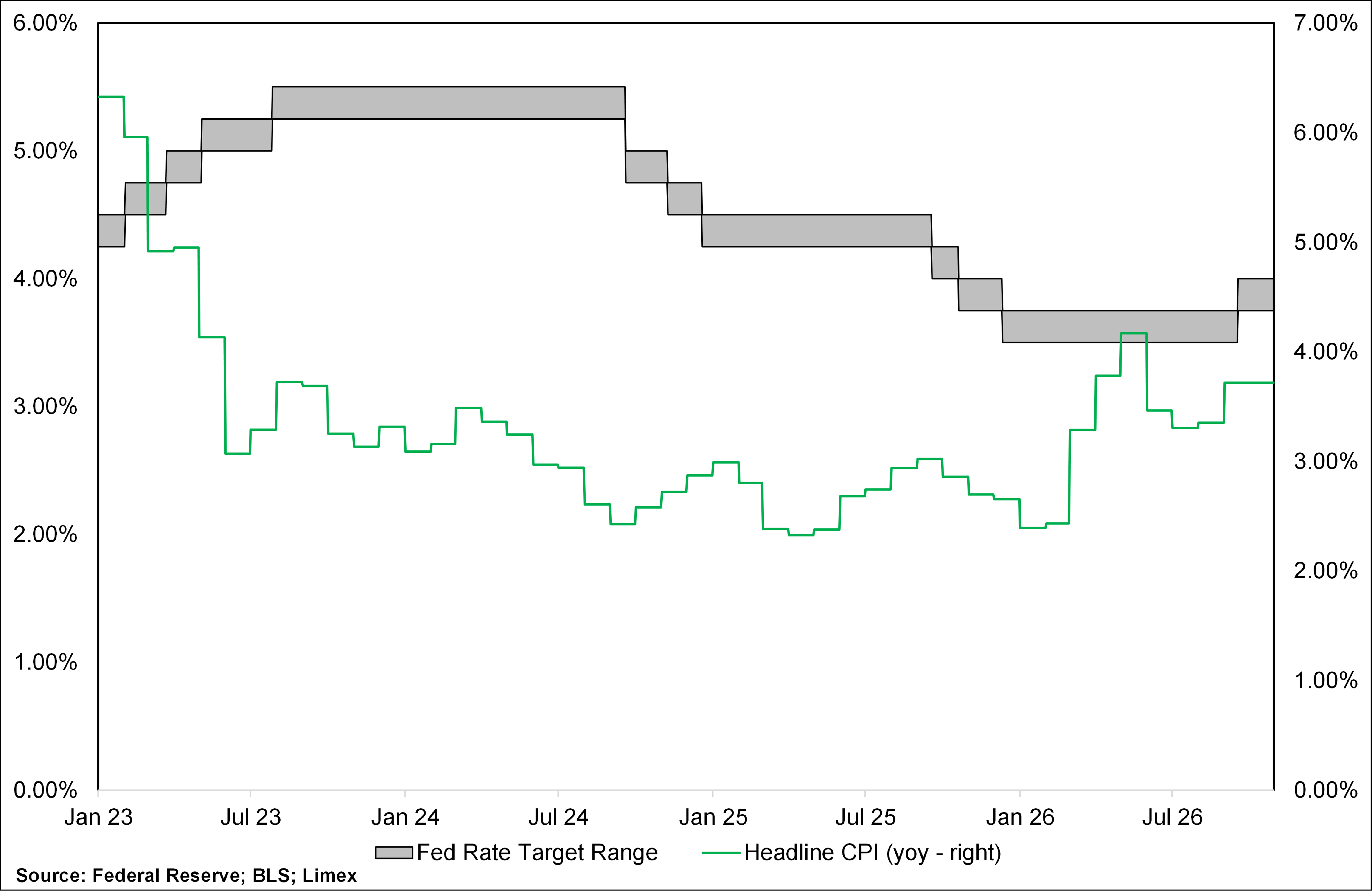
The distinction is important. it’s not that inflation has ceased to be a concern, or that the Fed is preparing to ease monetary policy. Rather, the Committee may have sufficient room to allow its previous tightening to work through the economy before deciding whether any further action is necessary.
The Fed is likely not finished tightening. But, it has no compelling reason to rush.
2. Monetary Policy Needs Time to Work
Monetary policy operates with long and variable lags. Changes in the federal funds rate transmit through bank lending, corporate financing, household borrowing, and capital investment before ultimately affecting aggregate demand and inflation.
These effects do not occur simultaneously. Financial markets may reprice almost immediately, but businesses take time to revise investment plans, households adjust consumption gradually, and existing debt obligations often reprice only as they mature or are refinanced.
September's rate increase has therefore barely begun to work its way through the real economy.
This creates an important distinction between maintaining restrictive monetary conditions and making those conditions progressively more restrictive.
Successive rate increases can compound their effects even when the initial economic response appears modest. By the time weakening demand or deteriorating credit conditions become evident in the data, considerable additional tightening may already be in the pipeline.
The Fed also has little reason to accelerate this process. Inflation remains elevated, but not out of control. Bringing it back to the 2% target a little faster is not necessarily worth sacrificing substantial economic growth, employment, and investment.
Moreover, much of the recent inflationary pressure reflects higher energy costs associated with the conflict involving Iran. Monetary tightening cannot restore disrupted energy supplies or resolve geopolitical uncertainty. It can only suppress demand to offset their inflationary consequences, potentially imposing additional costs on an economy already absorbing higher energy prices.
The relevant risk is that these supply-driven price increases become embedded in wages, services, and inflation expectations. Unless that happens, some of the inflationary pressure may dissipate as energy markets stabilize, without requiring further monetary intervention.
In the absence of urgency, it is likely that the Fed can afford to wait, observe the effects of September's hike, and allow existing monetary restrictions to do their work.
3. High Rates Still Matter for Stocks
For equity investors, the distinction between the direction and the absolute level of interest rates is particularly important.
Markets tend to concentrate on whether the next Fed decision will be a hike, a cut, or a pause. But the economic and financial consequences of monetary policy depend at least as much on the level at which interest rates remain.
Interest rates may stop rising without becoming accommodative.
At 3.75–4.00%, the federal funds target is elevated relative to the exceptionally inexpensive financing conditions that prevailed for much of the post-Global Financial Crisis period, although it is hardly unusual as compared to prior historical standards.
It’s not that interest rates are exceptionally high in absolute historical terms. It is that much of today's equity market has developed around expectations of more recent abundant, inexpensive capital.
Moreover, the Fed controls the short end of the yield curve, not the long-term cost of capital faced by businesses and households.
Longer-term Treasury yields reflect expected short-term interest rates, inflation expectations, real yields, term premia, and the balance between the supply of and demand for government securities.
Consequently, even an extended pause in the federal funds rate does not guarantee lower long-term borrowing costs. Persistent inflation, substantial Treasury financing requirements, and greater sensitivity to duration risk could keep longer-term yields elevated independently of additional Fed hikes.
For stocks, this matters generally through two principal channels.
First, higher discount rates reduce the present value of future corporate cash flows, particularly for businesses whose valuations depend heavily on profits expected many years into the future.
Second, elevated financing costs increase the required return on new investment, reducing the attractiveness of projects that may have appeared profitable when capital was cheaper.
Even if growth materializes exactly as expected, the value of that growth can still decline. The investment required to achieve growth becomes more expensive to finance, reducing the economic returns generated, while higher discount rates simultaneously reduce the present value of the resulting cash flows. In other words, companies can deliver on their growth forecasts and still disappoint shareholders.
For current equity analysis, this shifts the emphasis from growth expectations to the economics of financing that growth.
Self-financing businesses with strong balance sheets, durable free cash flow, and returns comfortably above their cost of capital may be better positioned to absorb higher financing costs. Companies whose growth depends on repeated external financing may face greater pressure, particularly where investment returns leave little margin for error. However, these characteristics alone do not determine stock performance or eliminate the risk of loss. This distinction cuts across conventional growth-versus-value and industry classifications. Two companies can deliver identical growth and produce very different outcomes for shareholders.
The investment question is no longer simply how fast a company can grow, but how much capital that growth consumes, the current costs of capital, and how much value remains for shareholders.
A Fed pause does not change that arithmetic.
© 2026 Securities are offered by Lime Trading Corp., member FINRA, SIPC, & NFA. Past performance is not indicative of future results. All investing incurs risk including, but not limited to, the loss of principal. Additional information may be found on our Disclosures Page. The material in this communication is not a solicitation to provide services to customers in any jurisdiction in which Lime Trading is not approved to conduct business. The material in this communication has been prepared for informational purposes only and is based upon information obtained from sources believed to be reliable and accurate; however, Lime Trading Corp. does not warrant its accuracy and assumes no responsibility for any errors or omissions. The information provided is not an offer to sell or a solicitation of an offer to buy any security or commodity or other financial product and is not a recommendation to follow a specific trading strategy. Lime Trading Corp. does not provide investment advice. This material does not and is not intended to consider the particular financial conditions, investment objectives, or requirements of individual customers. Before acting on this material, you should consider whether it is suitable for your particular circumstances and, as necessary, seek professional advice.